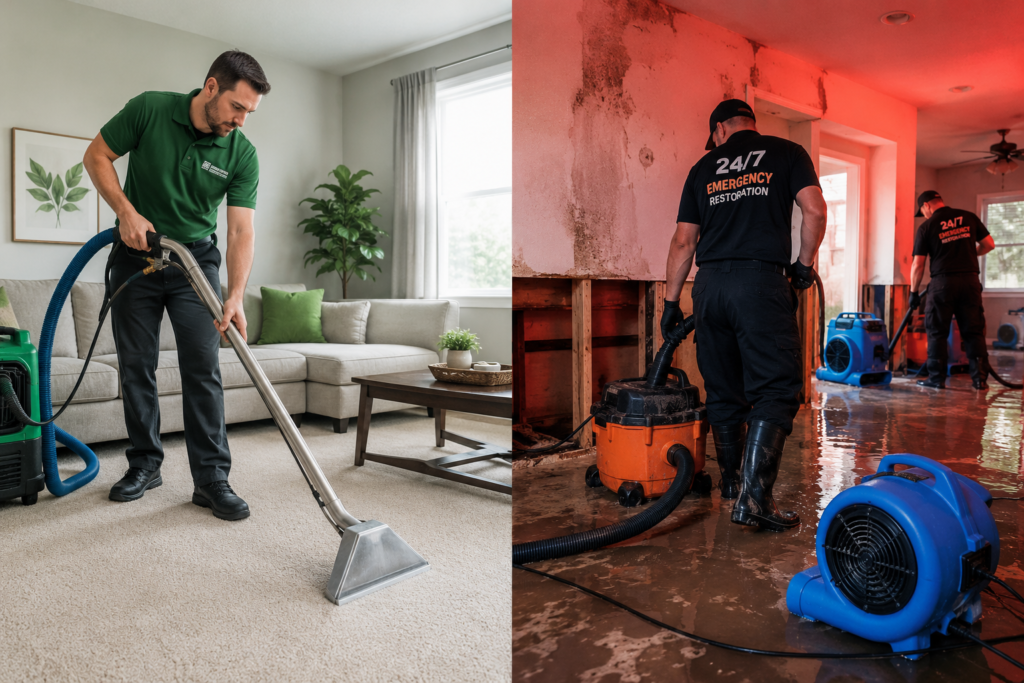
Your carpet is soaking wet. Maybe a pipe burst overnight, maybe the washing machine overflowed, maybe last night’s Texas thunderstorm found a way through your back door. You need help and you need it now.
But here’s the question most homeowners don’t know to ask: Do you need a carpet cleaner or a water damage restoration company?
They sound similar. They both involve water and flooring. But they are fundamentally different services and calling the wrong one could cost you thousands of dollars and lead to mold, structural damage, or a denied insurance claim. This guide explains exactly what each service does, when you need one versus the other, and how to make the right call for your home and your budget.
Table of Contents
- What Is Professional Carpet Cleaning?
- What Is Water Damage Restoration?
- The 7 Key Differences: Side-by-Side Comparison
- The 3 Categories of Water Why They Change Everything
- Which Service Do You Actually Need?
- The 48-Hour Mold Window: Why Timing Is Critical
- Insurance, Claims, and Who Covers What
- What Happens During Each Service (Step by Step)
- Cost Comparison: What to Expect
- Frequently Asked Questions
1. What Is Professional Carpet Cleaning?
Professional carpet cleaning is a maintenance and hygiene service designed to remove soil, allergens, pet dander, stains, odors, and everyday buildup from carpet fibers. It is scheduled, non-emergency work that improves the look, smell, and indoor air quality of your home.
The most common methods used by certified carpet cleaning professionals include:
- Hot water extraction (HWE / steam cleaning): The industry gold standard. Hot water is injected into carpet fibers and immediately extracted along with loosened soil. Recommended by most carpet manufacturers and certified by the IICRC (Institute of Inspection, Cleaning and Restoration Certification) as the preferred cleaning method for residential carpets.
- Dry cleaning / low-moisture cleaning: Compound or encapsulation methods using minimal water, ideal for commercial spaces or areas that can’t sustain extended drying time.
- Bonnet cleaning: A surface-level method using a rotating pad, often used for routine maintenance in commercial settings.
- Shampooing: Older method; less common today due to residue issues.
Carpet cleaning is appropriate when your carpet is dirty, stained, odorous, or due for routine maintenance. It is not designed and should not be used as a substitute for flood mitigation or structural drying.
A professional carpet cleaner typically works with truck-mounted or portable HWE machines, pre-treatment solutions, and deodorizers. Their job ends when the carpet is clean and drying. They do not carry industrial drying equipment, moisture meters, or mold remediation certifications.
When Carpet Cleaning Is the Right Call
Schedule a professional carpet cleaning when:
- Your carpets look dingy, matted, or discolored from normal foot traffic
- You’re dealing with pet odors, allergens, or built-up dander
- A small, isolated spill (coffee, wine, pet accident) was treated promptly and is now dry
- You’re moving in or out of a home
- You haven’t had a professional cleaning in 12–18 months
- You want to maintain your manufacturer’s warranty (most require professional cleaning every 12–18 months)
2. What Is Water Damage Restoration?
Water damage restoration is an emergency response service that addresses the full scope of damage caused by unwanted water intrusion. It goes far beyond the carpet surface it involves structural drying, moisture mapping, contamination control, mold prevention, and in many cases, demolition and reconstruction.
Water damage restoration companies are staffed by certified technicians typically holding IICRC Water Damage Restoration Technician (WRT) or Applied Structural Drying (ASD) certifications who understand how water migrates through a building’s structural components. When your carpet gets wet from a flood or leak, the carpet is often the least of your worries. The real danger is in:
- The carpet padding, which absorbs several times its weight in water and becomes a breeding ground for mold
- The subfloor (plywood, OSB, or concrete), which can warp, rot, or develop mold colonies
- The drywall at the base of walls, which wicks moisture upward and can collapse
- Wall cavities, where insulation holds moisture against structural framing
- Crawl spaces and basements, where water accumulates and conditions for mold are ideal
Critical:According to the U.S. Environmental Protection Agency (EPA), mold can begin to grow on wet building materials within 24 to 48 hours of water exposure. Water damage restoration is a race against this clock and a carpet cleaner’s equipment simply isn’t built to win it.
Restoration companies deploy industrial-grade equipment including high-capacity truck-mounted extractors, LGR (Low Grain Refrigerant) dehumidifiers, axial and centrifugal air movers, injectidry systems for wall cavities, and thermal imaging cameras to find hidden moisture. Their process is governed by IICRC S500 Standard the industry benchmark for professional water damage restoration.
3. The 7 Key Differences: Side-by-Side Comparison
Here’s how professional carpet cleaning and water damage restoration differ across every major dimension:
| Factor | Carpet Cleaning | Water Damage Restoration |
|---|---|---|
| Purpose | Hygiene, appearance, maintenance | Emergency mitigation, structural drying, mold prevention |
| Trigger | Scheduled / routine need | Emergency water intrusion event |
| Scope | Carpet fibers and surface | Full building structure: carpet, pad, subfloor, walls, cavities |
| Equipment | HWE machines, cleaning solutions | Industrial extractors, LGR dehumidifiers, air movers, thermal cameras, moisture meters |
| Certifications | IICRC CRT (Carpet Cleaning Tech) | IICRC WRT, ASD, AMRT (Mold), RRP (Lead) |
| Timeline | Hours (same day in/out) | 3–5+ days of active drying; may extend to weeks for reconstruction |
| Insurance involvement | Rarely covered (routine maintenance) | Often covered under homeowner’s policy (sudden/accidental water damage) |
4. The 3 Categories of Water Why They Change Everything
Not all water is the same. The IICRC S500 Standard classifies water intrusion into three categories based on contamination level. This classification determines whether carpet can be saved, who needs to handle it, and what level of personal protective equipment is required.
Category 1 Clean Water. Water from a sanitary source burst supply line, clean appliance overflow, rainwater (before contact with structural contaminants). Lowest risk; carpet and pad may be salvageable if dried within 24–48 hours. Professional restoration is still required; carpet cleaning alone is insufficient.
Category 2 Gray Water. Water containing significant contamination overflowing washing machines, dishwasher discharge, toilet overflow (urine only). Contains biological agents. Carpet may be salvageable depending on contact time, but padding typically must be replaced. Requires disinfection, not just cleaning.
Category 3 Black Water. Grossly contaminated water sewage backup, floodwater from rivers or storm systems, water that has been standing for more than 48 hours. Carpet, padding, and often drywall must be removed and disposed of. This is a biohazard situation requiring certified restoration professionals with proper PPE. A carpet cleaner cannot and should not attempt to handle this.
Important: Water category can change over time. Clean water (Category 1) that sits for more than 24–48 hours degrades to Category 2 or Category 3 as it picks up microbial contamination from the building materials it contacts. This is another reason why rapid response is essential.
Homeowners often assume their situation is Category 1 and attempt to clean or dry it themselves. What they can’t see is that bacteria and mold begin colonizing in the padding and subfloor long before any visible sign appears. A professional restoration company uses moisture meters and ATP testing to accurately assess the true contamination level.
5. Which Service Do You Actually Need?
Use this quick decision framework to find your answer:
You Need Carpet Cleaning If…
- Carpet looks or smells dirty from normal use
- You have pet stains or odors from accidents caught promptly
- A small isolated spill was treated immediately and is now fully dry
- You’re doing seasonal maintenance or pre-move cleaning
- Your carpet hasn’t been professionally cleaned in over a year
- There was no flooding, leaking, or water intrusion event
You Need Water Damage Restoration If…
- A pipe burst, appliance overflowed, or water intrusion event occurred
- Any area of carpet or flooring feels wet, spongy, or damp
- You can smell musty or mildew odors especially in enclosed areas
- You see standing water anywhere in the structure
- Baseboards, drywall, or cabinetry show signs of water contact
- A storm, flood, or sewage backup affected your home
- You’re unsure when in doubt, call restoration first
Pro TipIf you’re on the fence, err toward calling a water damage restoration company first. A reputable restoration company will honestly assess your situation and tell you if you actually just need a carpet cleaner. The reverse is not always true a carpet cleaner may not recognize the signs of deeper structural moisture.
What About Both?
In many cases, you’ll need both services just not at the same time. Water damage restoration comes first: emergency extraction, structural drying, mold prevention, and any necessary demolition and rebuild. Once the structure is fully dry and cleared, professional carpet cleaning may be appropriate for any salvageable carpet as a final finishing step before the space is re-occupied.
Think of it this way: restoration stabilizes and saves your home; carpet cleaning is the final polish once it’s safe and dry.
6. The 48-Hour Mold Window: Why Timing Is Critical
One of the most important facts every homeowner should know: mold does not wait.
Under the right conditions warm temperatures, organic material (carpet, drywall, wood), and moisture mold spores that exist naturally in virtually every home environment can begin germinating within 24 to 48 hours. Once mold takes hold in carpet padding or subfloor, the restoration process becomes dramatically more complex and expensive. In many cases, materials that could have been dried and saved must now be torn out entirely.
The Timeline of a Water Damage Event
| Timeframe | What’s Happening in Your Home | Salvage Outlook |
|---|---|---|
| 0–1 Hours | Water spreading; carpet surface and pad saturating; drywall beginning to absorb moisture at base | Excellent rapid response can save nearly everything |
| 1–24 Hours | Saturation deepening into subfloor; furniture staining carpet; metal items beginning to rust | Good professional restoration can typically save carpet and pad |
| 24–48 Hours | Mold growth begins; drywall swelling and paper facing delaminating; wood subfloor beginning to warp | Fair pad likely needs replacement; carpet survival depends on water category |
| 48–72 Hours | Mold visibly spreading; structural components compromised; biohazard risk elevated significantly | Poor significant demolition likely required; costs escalate sharply |
| 72+ Hours | Serious structural damage; mold remediation required before any restoration work; contents often unsalvageable | Very poor full remediation, demolition, and rebuild often necessary |
This is why water damage restoration companies operate 24 hours a day, 7 days a week, 365 days a year. Every hour counts. If you’re in the Rio Grande Valley region and dealing with an active water emergency, companies like McAllen TX Water Damage provide 24/7 emergency response and same-day extraction services because the difference between a $3,000 mitigation and a $25,000 rebuild can be measured in hours, not days.
7. Insurance, Claims, and Who Covers What
Understanding your homeowner’s insurance coverage before disaster strikes can save you significant money and frustration. Here’s how coverage generally breaks down though you should always review your specific policy carefully and consult with your insurance agent.
What Standard Homeowner’s Insurance Typically Covers
- Burst or frozen pipes-sudden and accidental; generally covered
- Appliance overflow-washing machine, dishwasher, water heater; generally covered if sudden
- Roof leak from storm damage-wind-driven rain damage may be covered; long-term leak from neglect usually is not
- Fire suppression water-damage from sprinklers or fire suppression; generally covered
What Standard Homeowner’s Insurance Typically Does NOT Cover
- Flooding from external water sources-storm surge, river overflow, groundwater requires separate flood insurance through the National Flood Insurance Program (NFIP) via FEMA
- Gradual or long-term leaks-a slow drip that went unaddressed for weeks or months is typically excluded as a maintenance issue
- Sewer backup-usually requires a separate sewer/drain backup endorsement
- Routine carpet cleaning-standard maintenance; not covered by any property insurance
Insurance TipDocument everything before cleanup begins. Photograph and video every affected area from multiple angles. A reputable water damage restoration company will provide moisture readings, written documentation, and drying logs all of which are essential for a successful insurance claim. Some companies will work directly with your insurer on your behalf.
Does My Policy Cover Mold?
Mold coverage varies widely by policy and state. Many policies cover mold remediation only if the mold resulted from a covered water damage event, and many cap that coverage at $5,000–$10,000. Mold resulting from a slow unaddressed leak or from delayed response to a known water event is frequently excluded. This is yet another reason why rapid professional response to any water intrusion is critical.
8. What Happens During Each Service (Step by Step)
The Professional Carpet Cleaning Process
- Pre-inspection: Technician assesses carpet type, fiber content, soiling level, and any problem areas.
- Pre-vacuuming: Dry soil removal before wet cleaning begins removes up to 75–80% of dry particulate.
- Pre-treatment: Traffic lanes and stained areas are treated with appropriate spotting agents and pre-conditioners.
- Agitation: A grooming tool or rotary machine loosens soil from the fiber and allows solutions to penetrate.
- Hot water extraction: High-pressure hot water is injected and immediately extracted, pulling soil, allergens, and cleaning solution from the carpet.
- Post-treatment: Spot treatment of any remaining stains; deodorizer application if needed.
- Grooming and drying: Carpet is groomed for uniform appearance; fans may be placed to accelerate drying (typically 4–8 hours).
The Water Damage Restoration Process
- Emergency contact and rapid response: Available 24/7; technicians typically on-site within 60–90 minutes of call.
- Inspection and moisture mapping: Thermal imaging cameras, pin and pinless moisture meters, and thermo-hygrometers map the full extent of moisture migration including inside walls, under flooring, and in cavities not visible to the eye.
- Water category assessment: Determines contamination level and appropriate PPE, antimicrobial treatments, and salvage decisions.
- Emergency water extraction: Industrial truck-mounted extractors remove standing water; specialty tools handle carpet, pad, and hard surfaces.
- Content manipulation: Furniture and belongings moved or blocked to prevent staining and allow full floor access.
- Demolition (if required): Non-salvageable materials carpet, padding, drywall, insulation are removed and disposed of per IICRC S500 guidelines.
- Structural drying: Industrial LGR dehumidifiers and high-velocity air movers are strategically placed; drying system reconfigured daily based on moisture readings. May include wall injectidry systems for cavities.
- Antimicrobial application: EPA-registered antimicrobials applied to all affected structural surfaces to suppress mold growth during drying.
- Daily monitoring: Technicians return daily (sometimes twice daily) to log moisture readings, reposition equipment, and document progress.
- Clearance and documentation: Drying is confirmed complete when all readings return to pre-loss baselines. Full documentation provided for insurance claim.
- Reconstruction (if needed): Many restoration companies offer full rebuild services reinstalling drywall, flooring, cabinetry, and finishing touches to return your home to pre-loss condition.
9. Cost Comparison: What to Expect
Cost varies widely based on home size, severity, water category, geographic market, and whether demolition and reconstruction are required. The figures below represent general national averages for reference always get multiple written estimates for your specific situation.
| Service | Typical Cost Range | Notes |
|---|---|---|
| Professional Carpet Cleaning (per room) | $40 – $80 / room $150 – $300 whole home | Out-of-pocket; not typically covered by insurance |
| Water Damage Mitigation (Cat 1, small area) | $1,500 – $3,500 | Clean water; limited affected area; no mold |
| Water Damage Mitigation (Cat 2, moderate) | $3,000 – $7,000 | May include partial demolition and pad replacement |
| Water Damage Mitigation (Cat 3 / major) | $7,000 – $25,000+ | Sewage, flooding, or delayed response; significant demolition |
| Mold Remediation (if required) | $1,500 – $10,000+ | Separate service; added when mold colonization confirmed |
| Full Reconstruction (after major event) | $10,000 – $100,000+ | Scope-dependent; typically covered by insurance for qualifying events |
The economics are clear: a $1,500–$3,500 rapid-response mitigation on a clean water event is infinitely preferable to a $25,000+ mold remediation and rebuild caused by delay. And most qualifying water damage events are covered by homeowner’s insurance meaning your out-of-pocket cost may be just your deductible.
Dealing With Water Damage in the Rio Grande Valley?
McAllen TX Water Damage provides 24/7 emergency water extraction, structural drying, and full restoration services for homeowners across Hidalgo County and the surrounding area. IICRC-certified technicians. Same-day response. Insurance documentation support. Get Emergency Help Now →
10. Frequently Asked Questions
Can a carpet cleaner dry out my flooded carpet?
In most cases, no. Standard carpet cleaning equipment is not designed for emergency water extraction at the volume and depth required after a flood, pipe burst, or appliance leak. While some carpet cleaning companies have wet-vac attachments, they cannot address saturation in the subfloor, pad, or drywall — which is precisely where mold growth and structural damage begin. A certified water damage restoration company is required for any true flood or water intrusion event.
How long does water damage have to sit before mold grows?
Mold can begin forming on wet materials in as little as 24 to 48 hours under typical indoor conditions. This is why water damage restoration is classified as an emergency service. The longer moisture remains in carpet, padding, and structural components, the higher the likelihood of mold colonization and the higher the eventual restoration cost.
Is it worth saving wet carpet, or should I just replace it?
It depends on two things: the category of water and how quickly you respond. Category 1 (clean water) intrusions caught and mitigated within 24–48 hours can often be dried and restored successfully. Category 2 or 3 events or any situation where water has been sitting for more than 48 hours almost always require carpet and pad replacement due to contamination or mold. A professional restoration company will provide an honest assessment of whether salvage is feasible and cost-effective.
Will my homeowner’s insurance cover water damage restoration?
Standard homeowner’s insurance typically covers sudden and accidental water damage burst pipes, appliance overflows, and similar events but generally excludes damage from flooding (which requires separate flood insurance), long-term unaddressed leaks, and gradual deterioration. Coverage for mold is limited and often capped. Always review your specific policy and document damage thoroughly before cleanup begins. A reputable water damage restoration company can help you navigate the claims documentation process.
How do I know if my carpet has hidden moisture damage?
Common warning signs include a persistent musty or mildew odor even after cleaning, carpet that feels damp or spongy underfoot, visible mold or dark discoloration at the carpet edges or near baseboards, and peeling, bubbling, or warping in adjacent flooring, baseboards, or drywall. However, the most serious moisture damage is often invisible to the naked eye. A water damage restoration professional uses pin/pinless moisture meters and thermal imaging cameras to detect hidden saturation that no visual inspection can find.
Can I use fans and a dehumidifier to dry my carpet myself?
Consumer-grade fans and dehumidifiers move a small fraction of the air volume compared to industrial restoration equipment and cannot dry structural components like subfloors and wall cavities at the rate required to prevent mold. DIY drying for any significant water intrusion is likely to produce surface-level results while leaving dangerous moisture trapped in the structure. The cost of professional restoration is almost always less than the mold remediation and structural repair bill that follows unsuccessful DIY drying.
Does carpet cleaning remove mold?
No. Carpet cleaning is not mold remediation. Steam cleaning and hot water extraction can kill some mold spores on the carpet surface but cannot address mold growing in the carpet backing, padding, subfloor, or wall cavities. Active mold requires certified mold remediation services following IICRC S520 standards which includes containment, air filtration, removal of contaminated materials, and clearance testing. Attempting to clean over mold without proper remediation will not resolve the problem and may spread spores.
The Bottom Line
Carpet cleaning and water damage restoration are not interchangeable services. One is planned maintenance; the other is an emergency response to a potentially life-altering property damage event. Knowing the difference and acting quickly when a true water damage situation occurs can mean the difference between a manageable repair and a major reconstruction project.
When in doubt, call a water damage restoration professional first. The assessment is typically free, and an honest company will tell you plainly whether you need full restoration services or simply a good professional carpet cleaning. Don’t let the similarity in names cost you your subfloor, your health, or your savings.
And when it’s time for routine maintenance the kind of annual deep cleaning that keeps your carpets looking great, smelling fresh, and lasting longer that’s what we’re here for.
Want to keep your carpets in peak condition year-round? Explore Our Professional Carpet Cleaning Services → Dowling Carpet Cleaning
Leave a Reply