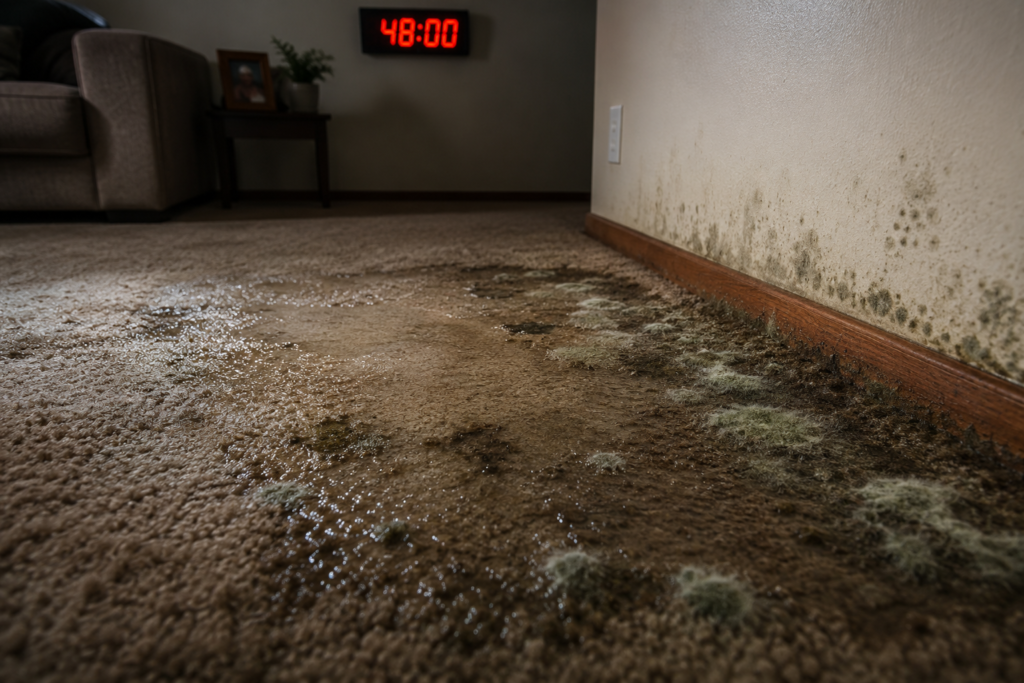
If your carpet got wet whether from a burst pipe, flooding, a leaking appliance, or even an overflowed toilet you might be asking yourself: how bad is this, really? Can I just dry it out and move on?
Here’s the honest answer most homeowners don’t want to hear: mold can begin forming on water-damaged carpet in as little as 24 to 48 hours. In some conditions, the process starts even faster.
This isn’t a scare tactic. It’s a biological reality that the EPA, FEMA, and water damage professionals all confirm. And understanding the timeline and what affects it could be the difference between saving your carpet and tearing out your entire subfloor.
In this guide, we’ll walk you through exactly how fast mold grows on wet carpet, what factors speed it up or slow it down, how to identify early mold, and what steps you need to take right now if your carpet is wet.
The 24–48 Hour Mold Timeline Explained
Mold doesn’t appear out of nowhere. It grows from microscopic spores that are already floating through the air in virtually every home. These spores are harmless when dry. The problem starts when they land on a moist surface like your carpet.
Here’s how the mold timeline typically unfolds after carpet gets wet:
0–12 Hours: The Dormant Window
In the first few hours, mold spores are beginning to absorb moisture. You won’t see or smell anything yet. This is your most critical window to act remove the water and begin drying aggressively.
12–24 Hours: Spore Activation
Spores that have absorbed enough moisture begin to germinate. Think of it like seeds that have just been watered. Still no visible mold, but the process is now underway beneath the surface inside the carpet padding and at the base of carpet fibers.
24–48 Hours: Mold Colonization Begins
Germinated spores start forming hyphae the root-like threads that anchor mold to a surface. At this stage, mold is actively establishing itself. You may start noticing a faint musty odor.
48–72 Hours: Visible Mold Possible
Depending on temperature, humidity, and the type of mold spores present, visible mold colonies can appear on carpet fibers within 48 to 72 hours. This is often first seen on the underside of the carpet or in the padding not the surface you walk on.
72 Hours+: Structural Risk Zone
After 72 hours of moisture exposure, mold can penetrate through carpet, into the padding, and begin affecting the subfloor beneath. At this stage, remediation becomes significantly more complex and expensive.
The Bottom Line: You have approximately 24 to 48 hours from the moment your carpet gets wet to dry it completely before mold becomes a serious risk. After 72 hours, the risk of permanent damage escalates rapidly.
What Factors Affect How Fast Mold Grows on Carpet?
Not every wet carpet will grow mold at the same rate. Several environmental and material factors determine how quickly mold takes hold:
1. Temperature
Mold thrives in warm environments. The ideal mold growth temperature range is between 77°F and 86°F (25°C–30°C) which is essentially room temperature in most American homes. In hot and humid climates like South Texas, conditions are nearly perfect for rapid mold growth year-round.
Cooler temperatures slow mold growth but do not stop it. Mold can still grow at temperatures as low as 40°F (4°C), just more slowly.
2. Humidity Levels
Relative humidity is one of the biggest drivers of mold growth. When indoor humidity rises above 60%, mold growth accelerates significantly. In cities like McAllen, TX where summer humidity frequently exceeds 80–90% wet carpet can develop mold faster than in drier climates.
3. Type of Water Involved
Not all water is equal. Restoration professionals categorize water damage into three categories:
- Category 1 (Clean Water): From a clean supply line or rain. Least contaminated, slightly longer mold window.
- Category 2 (Grey Water): From washing machines, dishwashers, or sump pump overflow. Contains microorganisms that accelerate mold.
- Category 3 (Black Water): From sewage backups, flooding from rivers or streams, or toilet overflows. Highly contaminated mold and bacterial growth can begin almost immediately.
Grey and black water situations dramatically compress the mold timeline. If your carpet was soaked with grey or black water, treat it as an emergency.
4. Carpet Material and Construction
Dense carpet with thick padding traps moisture more effectively and longer. Natural fiber carpets (wool, cotton) are more porous and absorb moisture deeper into the fiber. Low-pile synthetic carpets may dry faster on the surface but still retain moisture at the base.
The carpet backing and padding are often the real problem. Even when the surface of a carpet feels dry, the padding underneath can remain saturated for days creating a hidden mold incubator.
5. How Much Water Was Involved
A small spill that’s blotted up immediately is very different from a flood that soaks through the carpet into the subfloor. The volume and depth of water saturation directly impacts how long complete drying takes and therefore how much time mold has to establish.
6. Ventilation and Airflow
Poor airflow significantly extends drying time. A closed-up room with no fans, dehumidifiers, or air conditioning creates the humid, stagnant conditions mold loves. In contrast, aggressive air movement and dehumidification can dramatically shorten the mold window.
How to Tell If Your Carpet Already Has Mold
Sometimes mold develops before a homeowner even realizes the carpet was wet think slow leaks behind walls or under appliances. Here are the warning signs to watch for:
Visible Signs
- Black, green, gray, or white fuzzy spots on the carpet surface
- Discoloration or dark staining that doesn’t match a known spill
- Visible mold on carpet backing or baseboards adjacent to the carpet
Odor Signs
- Persistent musty, earthy, or stale smell that doesn’t go away with cleaning
- Odor that gets stronger when the HVAC system runs (mold spores circulating through the air)
- Smell concentrated near the floor or in one room
Health Signs
Mold exposure can trigger health symptoms including:
- Nasal congestion and runny nose
- Eye irritation
- Skin irritation or rashes
- Coughing or wheezing
- Worsening asthma or allergy symptoms
If multiple household members are experiencing unexplained respiratory symptoms, don’t dismiss it get your carpet and home inspected.
Important Note: Mold is most commonly found on the underside of carpet and in the padding not on the surface. A carpet can look perfectly clean and still be harboring an active mold colony underneath.
Can You Save Water-Damaged Carpet?
Whether your carpet can be saved depends on several factors:
Carpet May Be Salvageable If:
- The carpet was soaked with Category 1 (clean) water only
- It was wet for less than 24–48 hours
- No visible mold is present
- Aggressive drying begins immediately
- The padding has been removed (padding almost always needs to be replaced)
Carpet Should Be Replaced If:
- It was exposed to Category 2 or 3 water (grey or black water)
- It has been wet for more than 48–72 hours
- Visible mold is present anywhere on or beneath the carpet
- There is a persistent musty odor even after attempted drying
- The subfloor shows signs of moisture or mold
The carpet padding is a separate issue even if the carpet itself is salvageable, padding almost always needs to be replaced after significant water damage. Padding is cheap. Mold remediation is not.
The Danger of DIY Drying After Water Damage
Many homeowners try to handle wet carpet themselves renting fans, using a wet-vac, or opening windows. While immediate action is critical, DIY drying has significant limitations that most homeowners don’t fully appreciate.
What Consumer Fans and Wet-Vacs Can’t Do
- They can’t reach carpet padding. A wet-vac removes surface water, but moisture trapped in padding is nearly impossible to extract without professional equipment.
- They can’t measure moisture levels. Without a professional moisture meter, you have no way of knowing whether the carpet, padding, and subfloor are actually dry even if they feel dry to the touch.
- They create favorable mold conditions. Running a standard fan in a humid, enclosed room can actually increase humidity and worsen mold conditions if a dehumidifier isn’t also running.
Professional water damage restoration companies use truck-mounted or industrial dehumidifiers, high-velocity air movers positioned specifically for carpet drying, thermal imaging cameras to identify hidden moisture, and calibrated moisture meters to confirm drying to acceptable levels.
What Happens to the Subfloor When Carpet Mold Develops?
This is where water damage gets expensive fast.
When mold penetrates carpet and saturates the padding, moisture begins wicking into the subfloor. In most American homes, subfloors are made of plywood or OSB (oriented strand board) both of which are extremely vulnerable to mold and structural degradation when wet.
Subfloor Damage Timeline:
- 24–48 hours: Moisture begins penetrating subfloor surface
- 48–72 hours: Mold spores on subfloor begin germinating
- 3–7 days: Visible mold on subfloor; wood may begin to soften
- 1–2 weeks: Structural degradation; subfloor may require full replacement
Subfloor replacement can cost $500 to $3,000+ per room depending on extent and material. Compare that to the cost of calling a water damage restoration company within the first 24 hours and the value of fast professional response becomes clear.
When to Call a Professional Water Damage Restoration Company
If your carpet has been wet for more than 24 hours, if the source of water is grey or black water, or if you notice any musty odor or visible mold call a professional immediately. This is not a situation that benefits from a “wait and see” approach.
If you’re in the McAllen, TX area and dealing with water-damaged carpet or flooding in your home, the team at FloodFix Solutions-McAllen’s water damage restoration specialists responds 24/7 with certified technicians, professional drying equipment, and full mold remediation services. Fast response is everything in water damage and they understand the unique humidity challenges of the Rio Grande Valley.
Mold Prevention Steps While You Wait for Help
If you’re waiting for a professional to arrive, here’s what you should do right now:
- Stop the source. Shut off the water supply if the damage came from a broken pipe or appliance.
- Remove standing water with a wet-vac or mop. Get as much surface water out as quickly as possible.
- Lift the carpet if safe to do so. Pull back carpet edges to expose the padding and begin drying the back of the carpet.
- Run your air conditioning. AC units dehumidify the air as they cool this is critical in humid climates.
- Set up fans. Air movement slows mold growth by accelerating evaporation. Point fans directly at wet areas.
- Do not place plastic sheeting or tarps over wet carpet. This traps moisture and dramatically accelerates mold.
- Document everything. Take photos and video for your insurance claim before cleanup begins.
- Do not use bleach on carpet. Bleach kills surface mold but doesn’t penetrate to the roots and it damages carpet fibers.
The Role of Carpet Cleaning After Water Damage
Once a water damage professional has confirmed the carpet is structurally dry, professional carpet cleaning plays an important role in the restoration process.
Even after proper drying, water-damaged carpet can retain:
- Residual soiling carried in by floodwater
- Mineral deposits from hard water
- Residual microbial contamination
- Odors that persist in the fiber
Hot water extraction (steam cleaning) with antimicrobial treatment is the recommended method for post-water-damage carpet cleaning and it should be performed by a certified carpet cleaning professional, not a DIY rental machine.
The Carpet and Rug Institute (CRI) recommends hot water extraction as the most effective deep cleaning method for contaminated carpet.
Frequently Asked Questions
Q: Can mold grow under carpet without a water leak?
Yes. High indoor humidity alone especially in humid climates can cause condensation at the floor level, which can create enough moisture for mold growth under carpet, particularly over concrete subfloors.
Q: Does wet carpet always grow mold?
No, but only if it’s dried completely within 24–48 hours, and only if the water source was clean water. In warm, humid climates, the window is shorter.
Q: How can I test my carpet for mold?
Professional mold testing involves air sampling or surface swab testing by a certified industrial hygienist. Consumer mold test kits from hardware stores are unreliable. If you suspect mold, call a professional.
Q: Can I just remove the moldy section of carpet?
Only if the affected area is very small (less than 10 square feet) and the mold hasn’t penetrated to the subfloor. In most cases, significant mold growth requires full carpet and padding removal and remediation of affected materials underneath.
Q: My carpet smells musty but looks fine. Do I have mold?
Possibly. A musty odor is one of the earliest and most reliable signs of mold growth often present before mold becomes visible. Take the odor seriously and have the carpet and subfloor inspected.
Q: Is mold on carpet dangerous?
Yes, particularly for people with respiratory conditions, allergies, asthma, or compromised immune systems. Common carpet molds like Cladosporium, Penicillium, and Aspergillus can cause respiratory irritation, allergic reactions, and in some cases more serious health effects with prolonged exposure.
Final Thoughts: Time Is the Enemy After Water Damage
The single most important thing to understand about water damage and mold is that time is your biggest enemy. Every hour that wet carpet sits without professional-grade drying increases the likelihood of mold colonization and increases the cost and complexity of restoration.
In warm, humid climates like South Texas, that window can be even shorter. Don’t wait to “see how it goes.” Don’t assume the carpet will dry on its own. And don’t rely on consumer equipment to do a professional job.
If your carpet is wet right now, start the drying process immediately and get a water damage professional on the phone.
About Dowling Carpet Cleaning
At Dowling Carpet Cleaning, we specialize in professional carpet care that goes beyond surface-level cleaning. Whether your carpet needs routine maintenance or post-water-damage restoration cleaning, our certified technicians deliver results that protect your home and extend the life of your flooring. Learn more about our carpet cleaning services →
Leave a Reply