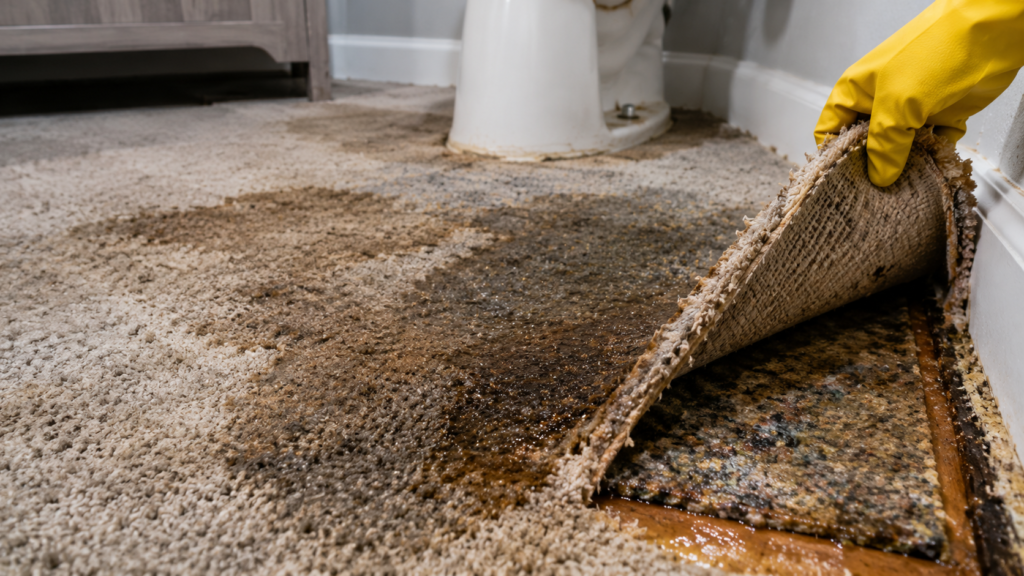
It’s one of the worst moments a homeowner can face: you walk into a room and find the carpet soaking wet — not from a burst pipe or a spilled glass of water, but from sewage. Whether it came from a backed-up drain, an overflowing toilet, or a sewer line failure, the situation is immediately alarming, and for good reason.
Sewage water isn’t just dirty. It’s a Category 3 water loss the most hazardous classification in the restoration industry and it brings with it bacteria, viruses, fungi, and parasites that can make you and your family genuinely sick. So the question isn’t just can you save the carpet. It’s should you, and how do you do it safely if so?
This guide breaks it all down in plain terms so you know exactly what you’re dealing with, what’s salvageable, and when you need to call in professional help immediately.
What Kind of Water Are We Actually Talking About?
Before anything else, it’s important to understand the water damage classification system used by restoration professionals. The Institute of Inspection, Cleaning and Restoration Certification (IICRC) defines three categories:
- Category 1 – Clean Water: Comes from a sanitary source like a broken supply line or a leaking faucet. Least hazardous.
- Category 2 – Gray Water: Contains some contaminants dishwasher overflow, washing machine discharge, aquarium leaks. Can cause illness if ingested.
- Category 3 – Black Water: Highly contaminated water from sewage backups, toilet overflows (containing feces), rising floodwater, and stagnant water. Contains pathogens that are potentially life-threatening.
A sewage backup or toilet overflow that involves fecal matter is always Category 3 (black water). There are no exceptions.
This classification matters enormously because it directly dictates how restoration professionals handle and whether they can save your carpet.
Can a Carpet Even Survive Sewage Contamination?
It depends on several factors, and in many cases, the carpet cannot be saved at all at least not the carpet pad underneath it.
The Carpet Itself
Whether the carpet can be cleaned and restored depends on:
- How long it was in contact with sewage water – The longer the exposure, the deeper the contamination and the greater the microbial growth. Anything over 24–48 hours dramatically reduces the chance of successful restoration.
- The type of carpet fiber – Some synthetic fibers are less porous and may be more amenable to deep extraction and antimicrobial treatment. Natural fibers like wool or cotton absorb more deeply and are harder to fully decontaminate.
- Whether the subfloor was affected – If sewage water has wicked into the subfloor (especially wood), the problem extends beyond the carpet and becomes a structural concern.
- Whether visible solids were present – If the sewage water carried solid waste material, the contamination level is categorically higher and restoration is far less feasible.
- How quickly professional response was initiated – Speed is everything in water damage scenarios. A rapid response can save materials that would otherwise need to be discarded.
The Carpet Pad: Almost Always a Loss
Carpet padding (also called carpet underlay) is almost always non-salvageable after a sewage event. Here’s why:
- Padding is made from porous foam or fiber that absorbs and holds liquid like a sponge
- Once contaminated with black water, it cannot be adequately dried or sanitized
- Bacteria and mold colonize the interior of padding and cannot be extracted with conventional cleaning
Even in cases where the carpet itself can be restored, the padding should be removed, bagged, and discarded as contaminated material. Attempting to dry and reuse contaminated padding is both ineffective and a health hazard.
The Health Risks You Cannot Ignore
This is not a situation where you can rely on your nose to tell you whether something is clean. Sewage contamination introduces a range of pathogens that can cause serious illness:
- E. coli (Escherichia coli) – Can cause severe gastrointestinal illness
- Salmonella – Leads to food poisoning-like symptoms including fever and diarrhea
- Hepatitis A – A liver infection spread through fecal-oral contamination
- Norovirus – Extremely contagious, causes vomiting and diarrhea
- Cryptosporidium and Giardia – Parasites that survive in water and resist many disinfectants
- Mold (various species) – Can begin colonizing within 24–48 hours in damp conditions
Children, elderly individuals, pregnant women, and anyone with a compromised immune system face elevated risks. Even healthy adults can develop serious infections after prolonged exposure to sewage-contaminated environments.
The Centers for Disease Control and Prevention (CDC) recommends treating any contact with sewage as a serious contamination event that requires protective equipment, proper cleanup protocols, and in many cases, professional remediation.
What To Do Immediately After a Sewage Backup
The first hour matters a lot. Here’s what to do before a professional arrives:
1. Stop the Source
If the backup is from a toilet overflow, shut off the water supply valve at the base of the toilet. If it’s a main sewer line, you may need to shut off the main water supply and call a plumber.
2. Protect Yourself
Before you step into the affected area, put on:
- Rubber or waterproof boots
- Rubber or nitrile gloves (disposable, not latex)
- A face mask at minimum an N95, ideally a respirator
- Eye protection (goggles)
- Disposable clothing or clothes you’re willing to wash in hot water immediately after
Do not touch your face while working in the contaminated area. Wash your hands thoroughly with soap and water or better, shower after any contact.
3. Ventilate the Area
Open windows and doors if possible. Turn on exhaust fans. Do not run the HVAC system as it can distribute contaminated air particles throughout the home.
4. Remove People and Pets from the Affected Area
Children and pets should not be in the area under any circumstances until professional cleanup is complete and the space has been cleared.
5. Document Everything
Before you move anything, photograph and video the entire affected area. This is critical for insurance claims. Document:
- The source of the overflow or backup
- The extent of water spread (how far it reached, what it touched)
- All affected materials (carpet, walls, furniture, baseboards)
- Any visible solid contamination
6. Call a Water Damage Restoration Professional Immediately
This is not optional. A Category 3 water loss requires licensed restoration professionals with the proper equipment, personal protective gear, and expertise. The longer you wait, the more damage compounds.
The Professional Restoration Process
When a certified restoration company arrives, here’s what the process typically looks like for a sewage-affected carpeted area:
Step 1: Assessment and Moisture Mapping
Technicians use moisture meters, thermal imaging cameras, and humidity sensors to determine the full extent of contamination and water intrusion. This step identifies whether the subfloor, walls, or adjacent rooms are affected beyond what’s visible.
Step 2: Containment
To prevent cross-contamination of clean areas, restoration crews typically establish containment barriers using heavy plastic sheeting. This is especially important in cases where sewage water may have reached HVAC vents or wall cavities.
Step 3: Extraction
Industrial-grade truck-mounted or portable extraction units are used to remove standing water and as much residual moisture as possible from carpet fibers. This equipment is exponentially more powerful than any consumer-grade wet-vac.
Step 4: Carpet and Pad Removal
In most Category 3 scenarios, the carpet is carefully pulled back and the pad is removed and disposed of as contaminated waste — usually in sealed, heavy-duty plastic bags. In many jurisdictions, contaminated building materials require specific disposal procedures.
Whether the carpet itself is rolled and set aside for potential treatment or also discarded depends on the assessment from Step 1 and the condition of the carpet.
Step 5: Subfloor Treatment
The subfloor is cleaned, treated with EPA-registered antimicrobial agents, and thoroughly dried. If the subfloor is wood and has been significantly saturated, structural drying equipment is deployed over multiple days.
Step 6: Antimicrobial Application
Professional-grade antimicrobial and disinfectant products which are not available to consumers are applied to all affected surfaces, including the underside of any carpet being retained, the subfloor, and the lower sections of walls.
Step 7: Structural Drying
High-velocity air movers and commercial-grade dehumidifiers are positioned to dry the space to pre-loss moisture levels. This typically takes 3–5 days depending on the severity of the water intrusion and ambient conditions.
Step 8: Clearance Testing
A legitimate restoration company performs moisture readings before packing up equipment to confirm the space has returned to safe moisture levels. Some companies also perform microbial testing or offer air quality testing as an add-on service.
When DIY Cleanup Is and Isn’t Appropriate
Let’s be direct: for most sewage backup situations, DIY cleanup is not appropriate.
Category 3 contamination involves genuine health hazards that require professional-grade biocides, extraction equipment, and disposal protocols. The average homeowner does not have access to any of these.
However, there are very limited scenarios where DIY efforts might be considered as a bridge measure before professionals arrive:
- The affected area is extremely small (under 10 square feet)
- The carpet is a cheap, easily replaceable rug or floor covering, not installed carpet
- You have proper PPE and can safely remove and bag the contaminated material
- You understand that DIY cleanup of black water is interim-only, not a substitute for professional remediation
In all other cases which is most cases attempting to clean sewage-contaminated carpet yourself with consumer cleaning products will not achieve the decontamination needed and may give you a false sense of security while bacterial and mold growth continues beneath the surface.
What About Carpet Cleaning Services? Can They Help?
This is where it gets nuanced.
Standard carpet cleaning hot water extraction, steam cleaning, dry cleaning is not appropriate as a primary treatment for Category 3 sewage contamination. These methods are not designed for biohazard decontamination.
However, professional carpet cleaning absolutely has a role in the post-restoration process:
- Once remediation has been completed and the area has been professionally dried and treated, a certified carpet cleaning service can perform a deep-cleaning treatment on retained carpet to restore its appearance and freshness
- Steam cleaning (hot water extraction) at appropriate temperatures combined with appropriate cleaning solutions can help address residual odor and surface-level soiling after the biohazard concern has been professionally resolved
- Encapsulation cleaning or enzyme-based treatments can help neutralize organic odors that linger after remediation
In other words: restoration first, carpet cleaning second. These are two separate and sequential phases, not alternatives to each other.
Signs Your Carpet Cannot Be Saved
Even after professional assessment, some carpets need to go. Red flags that indicate replacement is the better call:
- Carpet has been wet for 48+ hours before any treatment begins
- Visible mold growth on carpet fibers, backing, or adjacent surfaces
- Persistent odor after multiple professional treatments a sign contamination has reached the backing or fibers are permanently impregnated
- Structural saturation of the subfloor when the subfloor itself has been compromised, pulling the carpet is part of the necessary remediation
- Carpet backing has delaminated the backing separating from the fiber layer is a sign of severe water damage that cannot be reversed
- Pre-existing age or wear if the carpet was already approaching end-of-life, the cost-benefit math rarely supports restoration
Insurance adjusters and restoration professionals will typically provide a written scope of work that indicates whether items are being cleaned in place, cleaned off-site, or replaced. Request this documentation for your records.
The Water Damage Restoration Piece: Why Carpet Is Just Part of the Picture
It’s worth stepping back to acknowledge something: when you’re dealing with a sewage backup or toilet overflow, your carpet is one piece of a much larger water damage event.
What lies beneath and around the carpet the subfloor, the baseboards, the drywall at the floor line, the framing can all absorb sewage water. Mold can begin growing within 24–48 hours in any of these materials, and it can do so invisibly, inside walls and under flooring.
This is why sewage events require a certified water damage restoration company, not just a carpet cleaner or a mop-and-bucket approach.
For homeowners in the Rio Grande Valley, FloodFix Solutions – water damage restoration in McAllen, TX provides emergency sewage cleanup and full water damage restoration services, including subfloor drying, antimicrobial treatment, and structural restoration for homes affected by sewage backups and toilet overflows.
Working With Your Insurance Company
Most homeowner’s insurance policies cover sewage backup damage, but often only as a separate endorsement, not as part of the standard policy. This is a critically important distinction that many homeowners only discover after a loss.
Steps to take with your insurer:
- Report the claim promptly – Many policies have time limits on when a claim must be reported after a loss event.
- Request an adjuster visit – Don’t accept a settlement based on phone estimates alone.
- Get independent documentation – Your restoration company’s assessment and moisture logs are your evidence. Keep copies of everything.
- Understand your policy language – Key terms to look for: sewage backup endorsement, water backup and sump overflow, and what is and isn’t covered under your specific policy.
The Insurance Information Institute has a detailed resource on understanding water damage coverage under homeowner’s policies worth reading before you assume anything is (or isn’t) covered.
Odor: The Last Battle
Even after a carpet has been professionally cleaned and the space has been dried, odor can linger. Sewage odor is caused by a combination of volatile organic compounds (VOCs), sulfur compounds, and microbial metabolites and some of these can penetrate deep into porous materials.
Professional odor remediation techniques include:
- Hydroxyl generation – Uses UV light to produce hydroxyl radicals that break down odor-causing molecules at the molecular level. Safe for use while the space is occupied.
- Ozone treatment – Highly effective at eliminating organic odors; however, the space must be vacated during treatment and for several hours afterward. Not appropriate as a standalone treatment if microbial contamination hasn’t been addressed first.
- Thermal fogging – A solvent-based fog penetrates porous materials and neutralizes odors within the material structure.
- Enzyme-based treatments – Enzyme cleaners break down organic matter that causes odors, effective especially on carpet fibers and subfloor surfaces when applied as part of a professional treatment protocol.
Persistent odor after cleanup is a signal that remediation is not fully complete. Don’t mask it address the source.
Final Verdict: Should You Save the Carpet?
Here’s a practical decision framework:
| Scenario | Recommendation |
|---|---|
| Small toilet overflow, no fecal matter, caught within 1 hour | Professional extraction + antimicrobial; possible save |
| Full sewage backup, caught within 12 hours | Professional remediation required; pad gone, carpet possibly salvageable |
| Sewage backup, 24–48 hour exposure | Expect to replace carpet and pad; subfloor assessment needed |
| Sewage backup, 48+ hours or visible mold | Replace carpet, pad, and possibly subfloor sections |
| Any sewage event involving solid waste on carpet | Replacement strongly recommended |
The honest guidance: don’t get too attached to the carpet. Flooring is replaceable. Your family’s health isn’t. In the cost-benefit analysis, replacement is often the cleaner, faster, and ultimately cheaper path when you factor in the cost of multiple professional treatments, the risk of incomplete remediation, and the potential long-term mold liability.
But when restoration is viable, it takes the right sequence: certified water damage remediation first, professional carpet cleaning second, and ongoing monitoring for moisture and odor to confirm the space is truly clean.
Need Your Carpet Cleaned After Water Damage Remediation?
If you’ve already gone through the water damage restoration process and your carpet has been cleared for cleaning, our team at Dowling Carpet Cleaning is equipped to provide deep extraction, enzyme treatment, and deodorizing services that restore the look, feel, and freshness of your carpet after a water event.
We work with homeowners at the post-remediation stage the right time to bring in professional carpet cleaning that finishes what restoration started.
Disclaimer: This article is for informational purposes only. Sewage backup events are biohazard situations that require professional assessment. Always consult a certified water damage restoration professional before attempting any cleanup of Category 3 water losses.
Leave a Reply