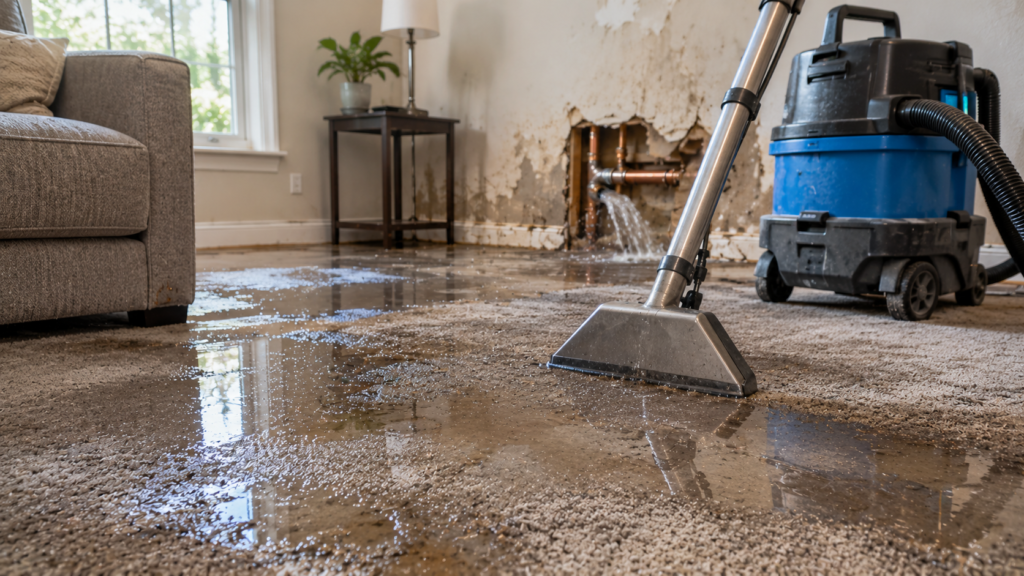
A burst pipe. A washing machine hose that finally gave out. A dishwasher seal that decided to retire without notice.
Whatever caused it, you’re now standing on soaked carpet and the clock is already ticking. Water damage doesn’t wait, and neither should you. The decisions you make in the first few hours after a carpet flood can be the difference between a full recovery and a full replacement.
This guide walks you through exactly what to do, what to skip, and where the line is between a carpet cleaning job and a water damage restoration job.
Why Wet Carpet Is More Dangerous Than It Looks
That soggy carpet isn’t just an inconvenience. Underneath it lies a layer of carpet padding and underneath that, your subfloor. Water travels fast, wicks downward, and hides in places you won’t see until the mold is already growing.
Here’s the timeline most homeowners don’t know:
- 0–24 hours: Water saturates carpet fibers and padding. Bacteria from the water source begin multiplying.
- 24–48 hours: Mold spores that are naturally present in any indoor environment begin to colonize wet materials.
- 48–72 hours: Active mold colonies become visible. Subfloor swelling and warping begins. Odors become embedded in fibers.
- 72+ hours: Structural damage and permanent mold contamination are likely. Carpet salvage becomes significantly harder and often cost-prohibitive.
According to the IICRC (Institute of Inspection, Cleaning and Restoration Certification), carpet affected by Category 2 or Category 3 water should be treated as contaminated and may require disposal rather than cleaning. This is the industry standard, and it matters when you’re deciding whether to DIY or call a professional.
Step 1: Stop the Source First
Before you touch the carpet, cut off the water supply. For a burst pipe, shut off the main water valve to your home. For an appliance leak, turn off the water supply line behind or beneath the unit and unplug the appliance.
Don’t skip this. Attempting to dry or clean carpet while water is still entering the space is pointless — and potentially dangerous.
Once the source is stopped, assess safety:
- Is the flooding near any electrical outlets, panels, or appliances?
- Is there standing water deeper than 1–2 inches?
- Is there any chance of sewage contamination (floor drain backup, toilet overflow)?
If any of those conditions exist, don’t enter the space until utilities are confirmed off and the area is inspected. Your life takes priority over your carpet.
Step 2: Classify the Water This Determines Everything
Not all water damage is equal. The IICRC classifies water into three categories that should guide your entire response:
| Category | Source | Risk Level | Carpet Salvageable? |
|---|---|---|---|
| Category 1 (Clean) | Supply lines, rainwater, broken pipes | Low | Usually yes, with fast action |
| Category 2 (Gray) | Washing machine discharge, dishwasher overflow, aquarium leaks | Moderate | Possibly, with professional cleaning |
| Category 3 (Black) | Sewage backup, floodwater, toilet overflow | High | No, disposal required |
Most burst pipe scenarios are Category 1. Most appliance leaks especially from dishwashers or washing machines are Category 2 due to detergent residue and biological matter. If you’re unsure, treat it as Category 2.
This classification matters because it determines whether you’re dealing with a carpet cleaning situation or a water damage remediation situation. Category 2 and 3 water exposures require professional restoration not a rental carpet extractor from the hardware store.
Step 3: Extract Standing Water Immediately
If there’s standing water on the carpet, your first job is extraction not scrubbing, not blotting, not waiting.
What works:
- A wet/dry shop vac run multiple passes in all directions
- A professional truck-mounted extractor (fastest and most thorough)
- A carpet wand or water claw attached to a wet vac (gets water from padding without tearing up the carpet)
What doesn’t work:
- Mops and towels they absorb but don’t extract from deep within padding
- Fans alone without extraction first you’re just evaporating surface moisture while the padding stays saturated
- Blotting effective only for very minor surface spills, useless for flood events
Run your wet vac slowly. You’ll be surprised how much water comes out on passes 3, 4, and 5 long after pass 1 seemed to pull everything up.
Step 4: Lift the Carpet and Inspect the Padding
Here’s a step most homeowners skip and pay for later.
Once you’ve extracted what you can through the carpet surface, you need to know what’s happening underneath. Pull back the carpet from a corner or along a wall and look at the padding.
Carpet padding is like a sponge. It holds water long after the surface carpet feels dry to the touch. If the padding is:
- Saturated – it needs to come out. Padding is inexpensive. Trying to dry it in place almost always leads to mold growth beneath the carpet.
- Lightly damp – aggressive drying may save it, but only if you can get airflow underneath the carpet.
- Dry or minimally wet – you may have caught it fast enough.
In most burst pipe or appliance leak scenarios involving significant water volume, the honest answer is: the padding needs to go. Remove it, bag it, and dispose of it. New padding costs a fraction of what mold remediation costs.
Step 5: Dry Aggressively The 48-Hour Window Is Real
With padding removed (or confirmed dry), your job now is to drop the moisture content of the carpet and subfloor below the threshold where mold can grow.
The tools that actually move the needle:
Air movers: These aren’t box fans. Restoration-grade air movers direct high-velocity airflow directly across wet surfaces. Rent or hire they make a significant difference over standard household fans.
Dehumidifiers: Extraction removes bulk water; dehumidifiers pull the remaining moisture vapor out of the air and materials. An undersized dehumidifier in a closed room is nearly worthless. A commercial LGR (Low Grain Refrigerant) dehumidifier in a properly sealed space is what professionals use.
Heat: Moderate heat accelerates evaporation but can also set stains and damage carpet backing if excessive. If you’re using any heating, keep it moderate and pair it with aggressive dehumidification.
Professional water damage companies use moisture meters to track progress a surface that feels dry to your hand may still be reading 18–25% moisture content, well above the safe threshold of around 12–15% for wood subfloors.
If you’re dealing with significant water damage to multiple rooms, or if the water involved anything other than clean supply-line water, this is the point where calling a water damage restoration professional is not just recommended it’s the smart financial move. For residents in the Rio Grande Valley, FloodFix Solutions at mcallentxwaterdamage.com provides emergency water damage extraction and structural drying with professional-grade equipment work that goes well beyond what carpet cleaning alone can address.
Step 6: Treat for Bacteria and Mold Don’t Skip This
Once moisture levels are down, the carpet and subfloor need antimicrobial treatment before any reinstallation or final cleaning.
Even Category 1 (clean) water carries bacteria once it’s been sitting in carpet for more than a few hours. Category 2 water should be treated as biologically contaminated regardless of contact time.
Effective treatments:
- EPA-registered antimicrobial products designed for carpet and subfloor use (not household bleach bleach is corrosive to carpet fibers and doesn’t penetrate deeply)
- Professional HEPA air scrubbing in the space during treatment
- Subfloor encapsulants if the subfloor itself was affected
Allow adequate dwell time per product instructions. Rushing this step and reinstalling carpet over an untreated subfloor is one of the most common and expensive mistakes made in DIY water damage restoration.
Step 7: Professional Carpet Cleaning (Now, Not Before)
This is where professional carpet cleaning comes in and notice that it’s Step 7, not Step 1.
Carpet cleaning companies deal with soiling, staining, odor, and fiber restoration. Hot water extraction (steam cleaning) is highly effective at removing residual contamination, detergent residue, sediment from floodwater, and musty odors that remain after drying.
But professional carpet cleaning cannot:
- Replace structural drying
- Extract water from saturated padding
- Remediate active mold
- Treat contaminated subfloors
Think of it this way: water damage restoration gets the carpet safe; carpet cleaning gets it clean. Both matter. They are not substitutes for each other.
A professional carpet cleaning after a water damage event should include:
- Pre-inspection and moisture confirmation (carpet must be dry before cleaning)
- Pre-treatment for any remaining biological contamination
- Hot water extraction with high heat
- Deodorization treatment
- Post-cleaning moisture check
If your carpet cleaner shows up while the carpet is still wet or doesn’t check moisture levels before starting, that’s a problem.
What to Skip: Mistakes That Make Things Worse
Don’t Use a Household Fan and Walk Away
A box fan blowing across saturated carpet creates one thing reliably: mold. It moves moisture-laden air without reducing the total moisture load in the carpet and padding. You need extraction first, then dehumidification, then airflow.
Don’t Assume the Carpet Is Fine Because It Looks Dry on Top
The surface dries before the padding does. Homeowners press their hand to the carpet after 12 hours, feel mostly dry fibers, and assume they’ve handled it. Padding can remain saturated for days beneath a surface that feels dry to the touch.
Don’t Steam Clean Wet Carpet
Steam cleaning a carpet that isn’t fully dry is counterproductive. You’re adding heat and moisture to a material that needs to lose moisture. This can accelerate mold growth, especially if the carpet is reinstalled shortly after.
Don’t Skip the Subfloor Inspection
Hardwood, OSB, and particleboard subfloors absorb water and swell. Mold growing under carpet on a damp subfloor is invisible until it’s a serious problem. Even if your carpet is salvageable, your subfloor may need drying time, antimicrobial treatment, or in severe cases, replacement.
Don’t Delay Calling for Help on Category 2 or 3 Events
This is the biggest mistake: assuming a rental extractor and a day of fans is equivalent to professional water damage restoration for anything beyond a minor clean-water spill. The difference isn’t just equipment it’s moisture measurement, protocol, and documentation (which matters enormously for insurance claims).
According to EPA guidelines on mold and moisture, mold can begin growing on wet building materials within 24 to 48 hours. Acting fast with the right equipment and the right sequence is how you avoid a carpet cleaning bill turning into a full remediation project.
When to Replace vs. Restore: Honest Guidance
Not every carpet is worth saving, and not every restoration attempt is cost-effective. Here’s a practical framework:
Replace the carpet if:
- Category 3 (sewage/floodwater) contamination occurred
- Mold is visible on the carpet backing or padding
- The carpet was wet for more than 48–72 hours without any professional intervention
- The subfloor beneath is damaged and requires significant repair (making carpet removal necessary anyway)
- The carpet is older and was due for replacement within a few years regardless
Restore the carpet if:
- Category 1 water source, caught within 12–24 hours
- Professional extraction and drying was initiated promptly
- No mold growth visible or detected
- Subfloor inspection shows clean, dry OSB or concrete
- Carpet is relatively new and in good condition
The IICRC’s Standard and Reference Guide for Professional Water Damage Restoration (S500) is the authoritative industry document on restoration decisions if you’re dealing with an insurance claim or a dispute about whether carpet can be restored, this is the standard your adjuster should be working from.
Dealing With Insurance After a Carpet Flood
Water damage from a burst pipe is typically covered under standard homeowners insurance as a sudden and accidental loss. Damage from a slow appliance leak that developed over weeks or months is usually excluded as a maintenance issue.
For covered events, document everything before any cleanup begins:
- Photograph and video the source, the affected areas, and the carpet condition
- Keep all damaged materials until your adjuster inspects (don’t haul padding to the dumpster before the claim is documented)
- Get itemized estimates from both a water damage restoration company and a carpet cleaning company
A well-documented claim from a professional restoration company is far stronger than a homeowner trying to reconcile rental equipment receipts. If you’re in South Texas and need emergency extraction and documentation for an insurance claim, the team at mcallentxwaterdamage.com handles the full scope from water extraction to drying documentation that holds up in the claims process.
Frequently Asked Questions
Can I save my carpet if it’s been wet for 24 hours?
Possibly, if the water source was clean (Category 1) and you begin aggressive extraction and drying immediately. After 48 hours, the odds drop significantly, and professional assessment becomes essential.
Does carpet cleaning remove mold smell?
Hot water extraction can reduce musty odors, but if the odor is from active mold growth rather than surface residue, cleaning alone won’t fix it. The mold source must be eliminated first.
How long does it take to dry a carpet after a water leak?
With proper equipment (air movers and commercial dehumidifier), a carpet and subfloor in a contained space can dry in 3–5 days. Without professional equipment, drying to safe moisture levels can take 1–2 weeks far past the mold growth window.
Is carpet padding always trash after a flood?
For any significant water intrusion, yes. Carpet padding has no practical way to be dried to safe moisture levels once fully saturated. It’s an inexpensive material; replace it.
What’s the difference between a water damage restoration company and a carpet cleaner?
Water damage restoration addresses structural drying, moisture measurement, subfloor treatment, and antimicrobial protocols. Carpet cleaning addresses soiling, staining, and surface hygiene. Most flood events need both, in that order.
The Bottom Line
Carpet cleaning after a burst pipe or appliance leak is real work but it’s the last step in a sequence, not the first response. Get the water out, get the padding up, get the materials dry, treat for contamination, then clean.
Skip any of those steps, and a carpet cleaning job becomes a mold remediation job. Skip all of them, and you’re replacing your subfloor.
If you’re dealing with more than a minor spill if there’s real water volume, if it’s been sitting for hours, if there’s any question about the water source bring in professionals for the restoration phase. For carpet cleaning once the space is properly dried and treated, that’s exactly where we come in.
Need help deciding whether your post-flood carpet is a cleaning job or a restoration job? Contact Dowling Carpet Cleaning. we’ll walk you through it honestly and connect you with the right resources if restoration comes first.
Leave a Reply