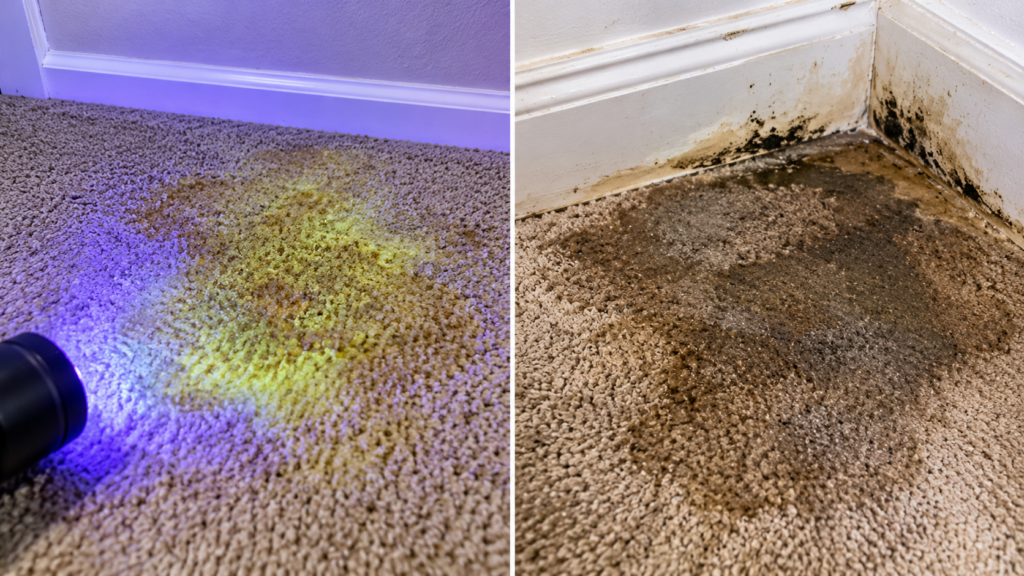
If you’ve ever knelt down to sniff a suspicious carpet stain don’t worry, we’ve all been there you know how confusing it can be to figure out what you’re actually dealing with. Is it your dog? A slow leak behind the wall? An appliance that quietly gave up overnight?
Getting the answer wrong isn’t just an inconvenience. Misidentifying the source means you apply the wrong treatment, the damage spreads, and you’re potentially dealing with mold, structural rot, or a health hazard that your carpet cleaner alone can’t fix.
This guide breaks down the exact differences between pet urine damage and water damage in carpet how to smell it, see it, feel it, and test for it and tells you when professional water damage restoration is the only right call.
Why This Confusion Happens
At first glance, a wet or discolored carpet patch looks the same whether your Labrador had an accident or a slow pipe leak has been saturating your subfloor for two weeks. Both can cause:
- Visible staining or discoloration
- Musty, unpleasant odors
- Damp or soft carpet texture
- Mold or mildew growth if left untreated
But the cause, the depth of damage, and the correct remediation method are entirely different. Treating water damage like a pet accident or worse, ignoring it as just the dog again can turn a $300 carpet cleaning job into a $5,000+ structural remediation project.
What Pet Urine Actually Does to Carpet
To understand the difference, you need to know what urine is doing to your carpet on a chemical and physical level.
The Chemistry of Cat and Dog Urine
Fresh pet urine is mostly water about 95% along with urea, creatinine, uric acid, bacteria, hormones, and ammonia compounds. In isolation, it’s mildly acidic when fresh. But as it dries, bacteria break down the urea into ammonia, which turns the chemistry alkaline. This chemical shift is important because:
- Alkaline substances bleach carpet dye especially in wool or natural fiber rugs
- Uric acid crystals form as the urine dries, bonding to carpet fibres and the backing
- These crystals are water-activated which is why old urine stains seem to “come back” after steam cleaning or a rainy day
Uric acid is the main reason DIY pet urine treatment fails. You can eliminate the ammonia smell temporarily with enzymatic cleaners, but if the uric acid crystals aren’t fully broken down, the odor returns as soon as the carpet gets humid.
How Deep Does Pet Urine Go?
This depends on pet size, volume, and how long it sat before treatment. A small fresh cat urine spot may only penetrate the top of the carpet pile. But a large dog urinating repeatedly in the same spot or urine left untreated for hours will soak through:
- The carpet pile (face fibers)
- The primary backing
- The secondary backing (usually polypropylene)
- The carpet pad
- The subfloor (wood or concrete)
Once urine reaches the subfloor, standard carpet cleaning cannot fully address it. The padding almost always needs replacement, and the subfloor may need sealing or antimicrobial treatment.
What Water Damage Actually Does to Carpet
Water damage from leaks, floods, or appliance failures behaves very differently from pet urine even when the visible symptoms look similar.
Source Categories Matter
The source of the water determines how urgently you need to act and how contaminated the carpet is. The IICRC (Institute of Inspection, Cleaning and Restoration Certification) classifies water damage into three categories:
- Category 1 (Clean water): From a supply line, rainwater, or broken water heater. Sanitary at the source, but can degrade quickly.
- Category 2 (Gray water): From washing machines, dishwashers, toilet overflow (no feces). Contains microorganisms and chemical contaminants.
- Category 3 (Black water): Sewage backup, floodwater, or any groundwater intrusion. Highly contaminated and requires professional remediation.
Most homeowners assume they’re dealing with Category 1 when they find a wet carpet, but if water has been sitting for more than 24–48 hours, it often degrades to Category 2 even from a clean source.
The Hidden Damage: What’s Under the Carpet
Water damage is uniquely dangerous because of what happens beneath the visible surface. Unlike pet urine, which wicks downward in a concentrated spot, water spreads outward. A leak from a refrigerator line or a slow plumbing drip can saturate a 50 square foot area of subfloor while the carpet surface looks barely damp.
Water damage can cause:
- Delamination – the adhesive bond between the carpet and its backing breaks down
- Subfloor rot – in wood subfloors, moisture above 19% triggers fungal decay
- Mold growth – Stachybotrys (black mold) and other species begin colonizing within 24–48 hours of moisture exposure
- Bacterial growth – especially in Category 2 or 3 scenarios
According to the EPA’s guide on mold and moisture, mold can begin growing on wet materials within 24 to 48 hours and may produce allergens, irritants, and in some cases toxigenic substances.
Side-By-Side Comparison: Pet Urine vs. Water Damage
| Factor | Pet Urine | Water Damage |
|---|---|---|
| Odor | Sharp ammonia when fresh; musty/stale when old | Musty, earthy; sewage smell if Category 3 |
| Stain appearance | Yellow, tan, or brownish rings; often multiple overlapping spots | Large irregular spreading patches; may appear as tide marks |
| Stain edges | Clear, rounded boundaries; often circular | Diffuse, spreading edges; follows gravity/floor slope |
| Location pattern | Near doors, furniture legs, corners, same spots repeatedly | Near walls, appliances, vents; follows a seam or slope |
| Carpet texture | Stiff or crusty when dry (uric acid crystals) | Soft, waterlogged, may delaminate |
| Smell test (wet cloth) | Ammonia or urine smell intensifies with warmth or moisture | Musty/mildew odor; sewage if contaminated |
| UV light test | Fluoresces yellow-green under blacklight | Does not fluoresce (unless organic contamination present) |
| Padding condition | Saturated in concentrated spots | Evenly saturated across larger area |
| Subfloor condition | May be stained/odorous in chronic spots | Higher risk of rot, mold, structural damage |
| Urgency | High (odor/hygiene) | Critical (mold/structure) |
The 5 Tests You Can Do Right Now
Test 1: The Blacklight Test
This is the gold standard for identifying pet urine. Urine fluoresces under UV/blacklight you’ll see yellow-green glowing patches in a dark room. Pure water damage does NOT fluoresce this way.
What you need: A UV flashlight (365nm wavelength works best). Turn off all lights, let your eyes adjust, and scan the floor slowly.
What you’ll see with pet urine: Glowing patches, often with multiple overlapping rings showing repeated spots.
What you’ll see with water damage: No fluorescence, or faint glow only if organic material (food, dirt) was in the water.
Test 2: The Smell Test
- Ammonia smell – pet urine (fresh or recently reactivated)
- Musty, earthy smell with no ammonia – mold/mildew from water damage
- Sewer/sulfur smell – possible Category 3 water damage (sewage backup or contaminated floodwater)
Try this: dampen a clean white cloth slightly, press it to the stain, cover with a warm towel for 5 minutes, then smell. Warmth reactivates uric acid odor.
Test 3: The Location Logic Test
Ask yourself:
- Is this near a spot my pet frequents? Near a door, kennel, furniture leg, or corner?
- Is this near a water source dishwasher, refrigerator, washing machine, exterior wall, bathroom wall, or under a window?
- Are there multiple similar spots in the same area (pet) or one large spreading area (water)?
Test 4: The Carpet Probe Test
Use a screwdriver or moisture meter probe and press into the carpet in the affected area vs. a dry area.
- Pet urine: The damaged area may feel stiffer or crunchier when dry; moist but localized when fresh
- Water damage: Large, uniformly saturated area; carpet may squish water when pressed; padding may be completely soaked
Test 5: The Moisture Meter Test
If you own or can borrow a pin-type moisture meter, probe the carpet and subfloor:
- Normal wood subfloor moisture: 6–11%
- At-risk level: 14–17%
- Active water damage: 20%+ (often much higher)
Pet urine, unless chronic, rarely elevates subfloor moisture readings significantly. Substantial water damage almost always shows elevated readings across a wider area.
When It’s Actually Both
This scenario is more common than most homeowners realize. A pet that has been repeatedly urinating in a corner can create enough chronic moisture to:
- Delaminate the carpet backing
- Saturate and compress the carpet pad
- Raise subfloor moisture enough to grow mold
Meanwhile, a slow water leak can draw a pet to the area and the pet starts urinating there now you have contaminated water and urine to deal with.
Signs you may be dealing with a combined scenario:
- Strong urine smell AND a large saturated area that doesn’t match your pet’s behavior
- Mold visible or smellable beneath carpet that has pet staining
- Subfloor damage in a chronic pet area
In these cases, standard carpet cleaning is not sufficient. You need a professional assessment.
Health Risks: How Serious Is Each?
Pet Urine Health Risks
- Ammonia irritation – upper respiratory irritation, especially for children and those with asthma
- Bacterial contamination – urine from sick animals may carry pathogens
- Allergens – dried urine residue can become airborne and trigger allergic reactions
- Psychological stress – persistent odor significantly affects quality of life
Water Damage Health Risks
Water damage carries escalating health risks depending on the category:
- Category 1: Low risk initially, but mold growth that develops within 48 hours elevates risk significantly
- Category 2: Contains bacteria, potential chemical contamination; direct contact risk
- Category 3: Severe contamination sewage pathogens, E. coli, hepatitis risk; direct contact dangerous; carpet typically must be discarded
Mold exposure from water-damaged carpet can cause:
- Respiratory issues and asthma exacerbation
- Chronic sinusitis
- Skin and eye irritation
- In sensitive individuals or those with weakened immune systems, more serious systemic effects
The CDC advises that any materials that remain wet or damp for more than 48 hours following a flood should be evaluated for possible mold contamination.
Bottom line: Pet urine is a hygiene and comfort problem. Water damage is potentially a structural and serious health problem. The urgency is different, and so is the required response.
DIY Treatment: What Works and What Doesn’t
For Pet Urine (Surface-Level, Recent Incidents):
What works:
- Blot immediately (never rub) remove as much moisture as possible
- Apply an enzymatic cleaner enzymes break down uric acid
- Allow full dwell time (30–60 minutes minimum) before blotting
- Rinse with cool water and blot dry
- Use a fan or dehumidifier to fully dry
What doesn’t work:
- Baking soda and vinegar (masks odor temporarily; vinegar can reactivate crystals)
- Steam cleaning old urine stains (heat sets uric acid bonds)
- Any cleaner without enzymatic action on old stains
When DIY fails: If the urine has reached the carpet pad or subfloor which most chronic spots have the pad must be pulled and replaced. No amount of surface cleaning will permanently eliminate the odour.
For Water Damage (Any Category):
What works temporarily for Category 1, small area, caught within hours:
- Extract standing water with a wet vac
- Remove furniture from area
- Lift carpet edges to allow airflow to pad and subfloor
- Run dehumidifiers and high-velocity fans (air movers)
- Monitor with moisture meter until readings return to normal (6–11% for wood)
What never works for water damage:
- Leaving wet carpet in place and hoping it dries on its own mold will win
- Treating the surface without addressing the pad and subfloor
- Attempting DIY remediation on Category 2 or 3 water
For anything beyond a small fresh clean-water spill, professional water damage restoration is the appropriate response and the sooner, the better.
When to Call a Water Damage Restoration Professional
Call a professional immediately if:
- The affected area is larger than 10 square feet
- The water source is unknown, sewage-related, or floodwater
- The carpet has been wet for more than 24 hours
- You detect a musty odor even after the carpet appears dry
- Your moisture meter reads above 16% in the subfloor
- You can see discoloration on walls or baseboards near the wet area
- Anyone in the household has asthma, allergies, or a compromised immune system
Professional water damage restoration involves industrial extraction, structural drying with professional-grade equipment, antimicrobial treatment, mold testing, and documentation for insurance purposes. This is not something that fans and a dehumidifier from Home Depot can replicate.
If you’re in the Rio Grande Valley area and dealing with water damage whether from a burst pipe, appliance leak, flooding, or anything in between FloodFix Solutions, McAllen’s water damage restoration specialists, can assess the situation and begin mitigation before mold takes hold.
Can a Carpet Cleaner Handle Water Damage?
A professional carpet cleaner can absolutely help with pet urine extraction, enzymatic treatment, pad replacement, subfloor sealing, and deodorization are all within the scope of a well-equipped carpet cleaning company.
Water damage is different: A carpet cleaner can assist with surface extraction and drying in minor, fresh, clean-water situations. But structural drying, contamination remediation, mold protocols, and insurance documentation require a licensed water damage restoration contractor.
Trying to clean your way out of water damage is like trying to bandage a structural fracture. The surface may look better temporarily, but the underlying problem continues.
Prevention: Protecting Your Carpet From Both
For Pet Urine:
- Address accidents immediately every hour of delay increases penetration depth
- Use enzymatic cleaners consistently don’t rotate between products
- Consider a professional deep clean twice yearly if you have multiple pets
- Area rugs with waterproof backing in high-risk zones
- Regular blacklight inspections find spots before they become chronic
For Water Damage:
- Inspect supply lines annually washing machines, refrigerators, and dishwashers are frequent culprits
- Know your water shutoff valve location every second counts in a pipe burst
- Install a water leak detector under sinks, near water heaters, and behind appliances
- Keep gutters clear roof and foundation water intrusion often starts here
- Act within hours if any carpet gets wet set up airflow immediately
Final Word: Trust Your Nose, Confirm With a Test
The fastest way to tell the difference between pet urine and water damage:
- Blacklight + ammonia smell = pet urine
- Large diffuse area + musty smell + no fluorescence + near a water source = water damage
- Both = combined scenario, professional assessment needed
Don’t guess and treat blindly. The cost of getting it wrong whether it’s a mold colony under your floor or a permanently odorous home that no buyer will touch is far greater than the cost of a proper assessment.
At Dowling Carpet Cleaning, we handle pet urine treatment, pad replacement, enzymatic deep cleaning, and deodorization at a professional level. For issues that go beyond the carpet water damage, structural moisture, or mold risk we’ll always tell you when it’s time to bring in a water damage restoration specialist before the problem grows.
Need to book a professional carpet cleaning in your area? Contact Dowling Carpet Cleaning today we’ll assess what you’re dealing with and give you an honest recommendation.
Leave a Reply